
1. Name an owner and an audience
Record the team responsible for the API, its intended consumers, its purpose, and its support path. Keep a discoverable catalog entry with the contract, environment URLs, and contact details. If nobody can approve a breaking change or answer a support question, the API is not ready to be shared.
2. Review the contract before implementation
Write an OpenAPI contract for request and response shapes, validation errors, authentication requirements, and pagination where relevant. Use consistent resource naming and explicit status codes. Include realistic examples so consumers can implement against the contract. Review it with at least one consumer before the provider code becomes difficult to change.
For example, a read-only customer summary can return only fields this caller is authorized to see:
GET /customers/c-1042
Authorization: Bearer <access-token>

200 OK
{ "id": "c-1042", "accountStatus": "active" }
Decide which fields are required, which are optional, and how unknown fields are handled. Add contract checks in CI so a change that breaks existing clients is visible before release.
3. Define access and data boundaries
Require transport encryption, authenticate callers, and authorize access to each operation and data set. Apply least privilege to service identities. Avoid putting sensitive values in URL query strings or logs; decide how secrets rotate and how personal data is retained. Rate limits and request size limits protect both the provider and other consumers.
4. Make operations observable
Publish availability and latency objectives that match the business need. Capture request IDs, response codes, latency, and dependency failures without logging secrets. Give consumers a way to correlate failures with provider logs. Document timeout behavior and whether retries are safe for each operation.
5. Plan versioning and retirement
Prefer additive, backward-compatible changes when possible. For a breaking change, choose a versioning strategy, state the migration path, and give consumers a clear deprecation window. Track usage before retiring a version rather than assuming nobody depends on it.
A good governance check answers: who owns this API, who uses it, how is it secured, how do we know it works, and how will it change?
Release gate
- Named owner, documented consumers, and published contract.
- Authentication, authorization, and data-handling review complete.
- Automated contract tests and an actionable error format.
- Operational dashboards, alerts, and a support route.
- Documented compatibility and deprecation policy.
Use case: one customer view for sales and support
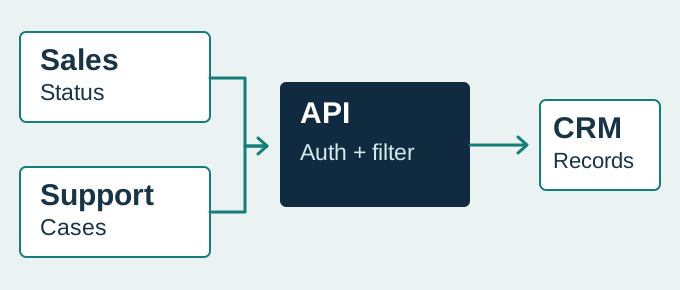
A sales team and a support desk both need customer contact and account status from the CRM. Separate direct connections have started to diverge: one exposes an outdated status field, while the other returns data support should not see. An owned customer API can publish a documented contract for the shared fields and apply consumer-specific authorization at the boundary.
Start with the two teams' actual read needs, define the smallest response each is allowed to access, and test those permissions. Give the API an owner, request IDs for tracing, and a versioning plan for any CRM migration. This reduces duplicate mappings without turning the API into an unrestricted copy of the CRM.
Use case: approved account context for a support assistant
A support assistant needs the current ticket state and selected account attributes to help an agent answer a question. Rather than granting the assistant direct CRM credentials, expose narrowly scoped read operations through a service identity. Filter sensitive fields at the API boundary, require authorization for the specific account, and return only the context needed for the agent's task.
Log which approved data was requested and correlate it with the support session without recording secrets or full personal records. Define retention, rate limits, and a fallback when the CRM is unavailable. Treat the assistant as another API consumer that must pass the same security and change-management checks as any other application.